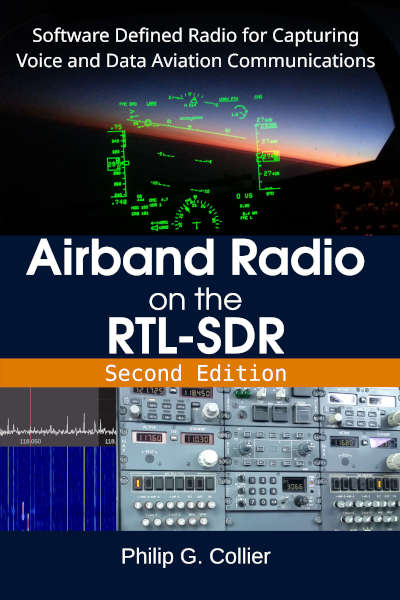
Whether for sheer enjoyment of spotting airplanes, or for tracking aircraft movements to understand corporate, government, or military activity, radio is an essential tool. Much of what is happening in the skies overhead is revealed by radio signals. At every moment, there are voice, operational data, and air traffic control communications available for you to hear and read, if you know how to intercept them. Airband Radio on the RTL-SDR teaches you how to use an inexpensive software defined radio to capture aircraft signals.
Airband Radio on the RTL-SDR explores how software defined radio receivers work, with specific emphasis on the strngths and weaknesses of the most popular little radio in a USB dongle. With an understanding of the RTL-SDR, the book then discusses the various types of signals available for intercept: AM mode voice, digital ACARS messages, and modern data modes such as VDL, ADS-B, satellite, and long range HF radio comms.
Airband Radio on the RTL-SDR also covers the inevitable move people make when they want higher performance from their radio hardware: improved antennas, low noise amplifiers, and higher spec computers or software. There will come a day when it is time to graduate from the RTL-SDR to true high performance radio equipment, for true state of the art signal intercepts. The book discusses what to seek when upgrade time arrives.
The author takes you on a journey based on multiple decades of airline flying and also as a licenced commercial and amateur radio operator. His experience with aviation radio communications extends back through more than fifty years
Read Airband Radio on the RTL-SDR today!
Because so many people misuse preamplifiers, I will bring up the topic again. Preamplifiers are for getting above the radio system’s internal noise and feedline losses, not for simply making everything loud.
...
In comparison to other makes of SDRs, the RTL dongles are more subject to overloading, so it is important to use only enough LNA and internal gain to hear the signals you want. The single gain setting adjustable in most software actually tweaks multiple stages within the RTL-SDR. The minimum setting results in a deaf device; maximum uses too much gain, resulting in noisy, overloaded, hellish reception. It is best to set a moderate gain, between about 15 and 30, where the device is sensitive yet able to accept the output of an external LNA. Adjust as necessary to receive distant signals without being overloaded by strong local signals.
After the LNA, it is smart to bandpass filter the RF signal. Commercial units are available for 1090 MHz, for ADS-B, while other broadband units are made by a few shops for airband. Since the larger problem for airband is overload due to FM broadcasters, a popular solution is to use a band stop or notch filter against them.
Coaxial cable from the antenna to SDR should be as short as practicable. I suggest a short to moderate run of cable to a place where it is convenient to affix a weatherproof and groundable metal case for the device. If the LNA has a lot of gain, you may actually benefit from a long cable run which would attenuate excess signal. If the dongle mount is near the host computer, run a USB cable to it.
A feature often undervalued by listeners is the IQ mode. It is useful for feeding a quadrature signal to an outboard recorder for capturing the actual RF waveforms being tuned, for later playback. Also, the IQ mode is useful for demodulating or decoding signals on outboard equipment. That means a listener can save and / or decode whatever is tuned in, whether a gaggle of AM signals on a busy frequency, VDL mode 2, or even a VOR signal fading in during some VHF enhancement.
Of course, for HF on the Web-888, IQ mode can be a source of signals for an outboard HFDL decoder for aircraft. If the decoder is on the same computer as the web browser connecting to the SDR, it is a simple matter to pipe the audio directly to that decoder. A synchronous AM demodulator is also available on the Web-888, although it is not so useful for the aviation bands. Aero signals tend to be intermittent and rapid-fire, such that the demodulator would have to jump around to sync with the various transmitters popping up on a frequency.
...
For recording wideband I/Q data directly from an SDR device, Linux systems can easily move data via pipes on standard out / standard in. It is a great way to save spectrum which you can play back later, tuning different frequencies within the recording as if listening live. Recording broadband spectrum requires considerable storage space, easily reaching into gigabytes for RTL-SDRs and terabytes for the monsters which can digitize 30 MHZ of spectrum at once.
© 2005 - 2026 AB9IL.net, All Rights Reserved.