UPDATED 06/26/2025: Fix punctuation and code.
UPDATED 03/31/2025: Refined and expanded comments regarding factors affecting dynamic range in QSD versus direct sampling radios.
QUADRATURE SAMPLING SDRs
The bleeding edge of radio technology was initially manifested in projects using quadrature sampling detectors feeding studio quality audio interfaces. Also known as "zero IF SDRs," Softrock Receivers and similar devices exhibited characteristics far superior to superheterodyne radios in the following categories:
- Dynamic range, thanks to superior "H mode" mixers.
- Stability, when the local oscillator is at least crystal controlles, if not oven stabilized or GPS disciplined.
- Signal purity, due to the quality oscillator mentioned above, plus high quality high bit depth audio ADCs.
- More signal purity made possible with theoretically perfect direct digital demodulation.
- Panoramic spectrum display, implemented in the software interface.
- Point and click tuning, implemented in the software interface.
For example, the Softrock, Flexradio, and RTL SDRs easily outperform most superhet radios in those five aspects. Innovative software makes these radios versatile and easy to use, but ultimately it is RF hardware with the first critical job: capturing a clear enough signal for manipulation in the digital domain.
Though the QSD based software defined radios are obviously an advancement beyond superhets, they do have some limitations related to bandwidth, dynamic range, and tuning range. The problem is that they are often created not as direct conversion radios, but as superheterodyne rigs with a QSD at the end of a wideband intermediate frequency (IF) circuit. These SDRs' operating range may be widely tunable, as for the RTL-SDR, but with a bandwidth limited by the A/D converter sampling rate. The QSD based SDR hardware samples chunks of spectrum in segments up to a few of MHz wide, and relies on a crystal oscillator, phase locked loop or direct digital synthesizer for setting its center frequency.
In the best cases, the SDR reference clock source is oven stabilized or GPS disciplined. However, cost cutting manufacturers have sometimes used clocks with jitter or phase noise, which adds to overall noise in the receiveng system. Not only are noise and distortion introduced during mixing in the QSD due to the oscillator, the system is further compromised by limitations of the mixer used to convert signals to the SDR IF frequency. The IF frequency is where there is some amplification and broad filtering before signals are passed to a QSD. Superior signal purity and low noise performance, therefore, is tough design challenge in all-band heterodyning QSD-based SDRs.
M0RZF has published an improved circuit design advancing the popular Mobo QSD based software defined radios. His work has very nicely improved the sensitivity, dynamic range, and useful bandwidth to the point that full HF coverage is possible without the need for a preamplifier. His Unity SDR also has better I/Q balance than the earlier designs, making overall performance MUCH better without the need for tweaks and adjustments after the circuit is built. He also makes a valid point that QSD based SDRs can be smaller, simpler, less expensive, and more energy efficient than their direct sampling counterparts.
DIRECT SAMPLING SDRs
Consider a more advanced SDR design: eliminate the mixer and oscillator by directly sampling the entire spectrum of interest, and implement all modulation, demodulation, filtering, and processing functions within a virtual transceiver. Very wide bandwidth A/D converters can digitize spectrum from near DC through VHF range, and feed the data stream to a processing engine. This method has fantastic potential! Consider a modest list of possibilities:
Note: this was written in the early 2010s, and has indeed happened. Note the direct sampling FlexRadio, KiwiSDR, and Web-888 SDR equipment. Government and military SDRs can do even more mind-boggling tricks with radio signals.
- High dynamic range due to use of one clock reference and elimination of heterodyning oscillators, hardware mixers and diode switched roofing filters.
- Very high performance multimode operation.
- Versatile multifrequency operation.
- Any manner of spread spectrum and high rate digital modes.
- Multiple virtual transceivers using one or many antennas.
- Synthetic phasing / beam forming for antennas.
- Streaming RF data to remote receiver interfaces via internet protocol.
- Very high definition reception and recording, limited by user's computing and storage hardware.
- Numerous possibilities for RADAR, radio astronomy, and other special modes.
There are some limitations to performance in direct sampling software defined radios. For high bandwidth sampling, the data flow is enormous - enough to stress the limits of modest desktop computers. Internal latency is a factor, and systems must be tweaked to minimize it. Also, while oscillator and mixers are removed from the RF signal path, the ADC clock absolutely must be accurate and steady to prevent distortion and noise due to clock instability. Excellent reference clocks are available, but they can be expensive. One issue which seems to NOT be a problem, especially when the operating range is sampled at a far higher minimum sampling rate: ADC overload. Flexradio experience has shown that when the HF range is sampled at a rate five times higher than the theoretical minimum, the summing of many strong signals rarely results in ADC overload. Simulations indicate that overloads would involve single samples and have no significant effects on a received signal.
A group of nearly 1000 talented radio amateurs and short wave listeners have been working on a "High Performance Software Defined Radio (HPSDR)" project with the goal of ceating the sort of direct sampling SDR under discussion here. In fact, the HPSDR group is creating hardware and software which greatly advances radio's state of the art. Their Mercury module is an early example of movement toward direct sampling SDR designs.
THE QUICKSILVER QS1R - AMAZING AND ELEGANT
|
|
|
|
|
|
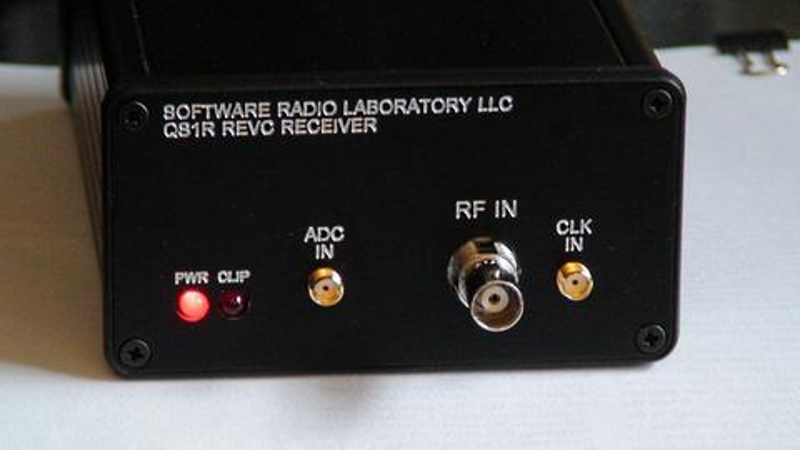
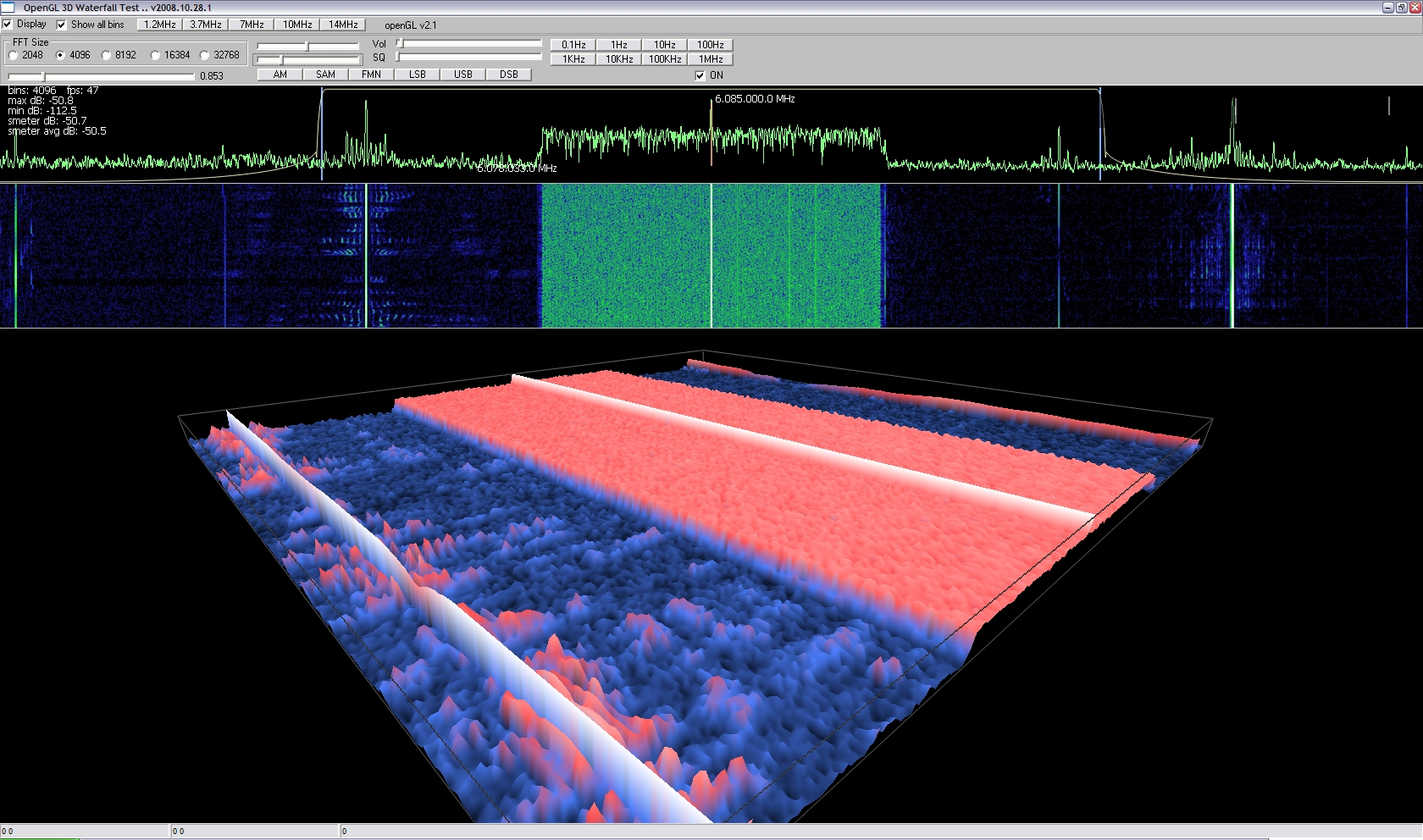
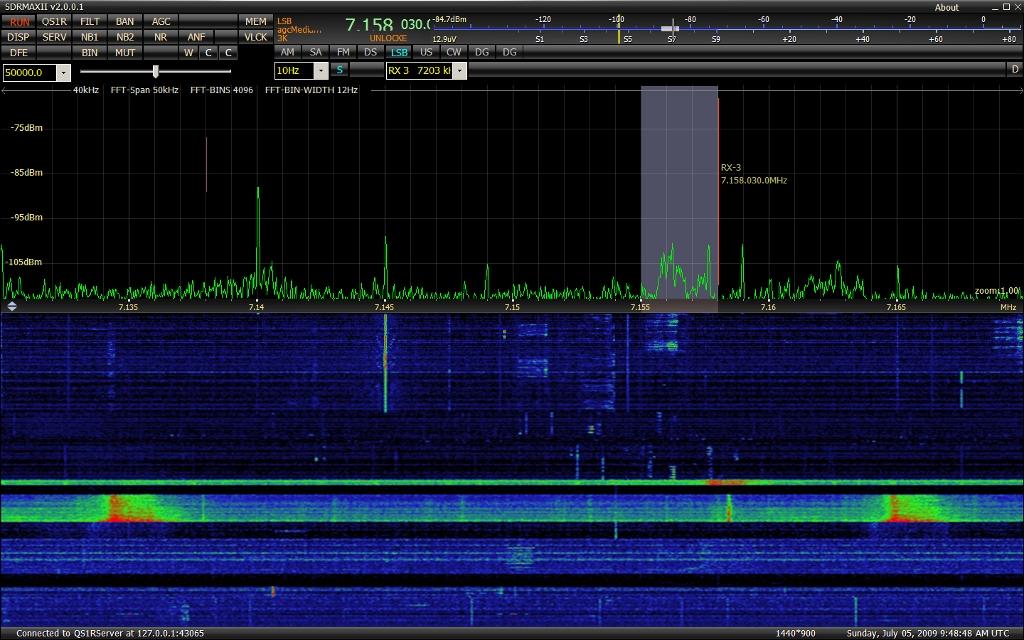
A ready-to use SDR currently available outside of military / government circles provides fantastic performance and very advanced features: the QS1R receiver (and soon a QS1T transmitter), made by the Software Radio Laboratory LLC. This radio is the result of intense brainstorming among numerous talented people, and more specifically, the work of a team led by Philip Covington (N8VB).
The QS1R has excellent specifications, and an in its most basic form, covers the range from 10 kHz to 62 Mhz, and through 300 MHz using undersampling techniques. With proper front end equipment, it can receive VHF, UHF, or microwave signals in a manner far more advanced than conventional communications gear. The unit uses a USB 2.0 interface for connection to the user's computer, and companion software is available for Linux, MAC, and Windows. SDRMax is the open source software for the QS1R. SDRmax may be examined, analyzed, modified, and evaluated by the end user community. With each update, more capabilities are added, and the Quicksilver SDR system continues to improve. Another excellent software interface for the QS1R is HDSDR Both of these software packages give the radio operator the ability to find and use radio signals in an intuitive and effective manner unimaginable in the past.
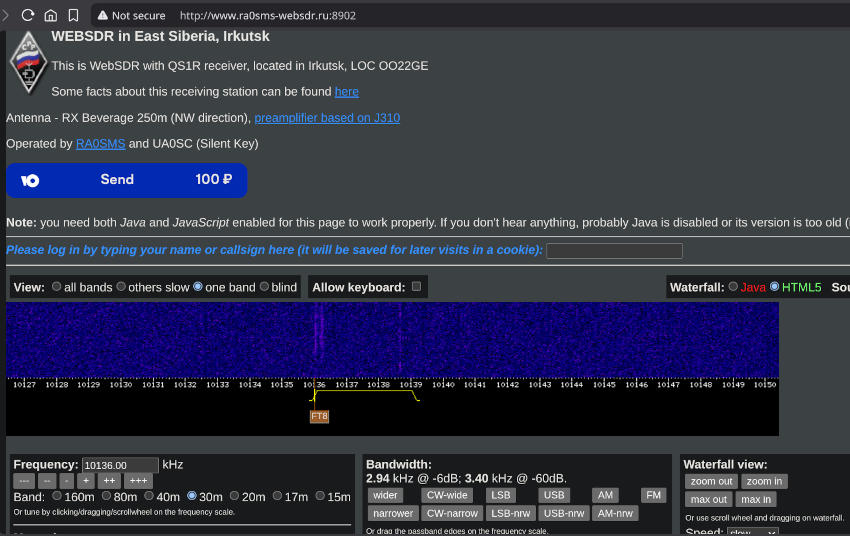
LISTEN TO A QS1R ONLINE
Since the original publishing of this article, the QS1Rs which were hosted online appear to have beeen taken down or switched to private access. However, there is still one QS1R receiver available for public access. Here is the information

QS1R SPECIFICATIONS

Frequency Coverage:	10 kHz – 62 MHz
Modes:			LSB, USB, CW, AM, SAM, FMN, FMW
Sensitivity:		0.56 uV SSB (S+N)/N= 10 dB
Selectivity:		120 dB
Image Rejection:	90 dB Input IP3 >42 dBm
Dynamic Range:		101 dB (SSB, 2.4 kHz BW) 104 dB (CW, 500 Hz BW)
SFDR:			112 dB
BDR:			126 dB (CW, 500 Hz BW)
MDS:			-121 dBm (500 Hz BW)
ADC Clipping Level:	+9 dBm ( 8 mW )
Ext. Encode Clock:	60 - 130 MHz, +10 dBm max.
ADC:			16 bit, 125 MSPS
FPGA:			Altera Cyclone II EP3C25
Audio DAC:		TI 24 bit stereo, 50 kSPS
Interface:		USB 2.0 High Speed ( typ. 32 MB/S Max )
Sampling Rates:		25, 50, 125, 250, 500, 625, 1250, 1562, 2500 (kSPS)
Output Bandwidth:	20, 40, 100, 200, 400, 500, 1000, 1250, 2000 (kHz)
Output Signal:		32 bit/sample I-Q pair
Power Supply :		+5 to +6 Volts @ 1000 mA typ.
Cabinet:		Anodized Aluminum 103 x 53 x 160 mm (W x H x L)
Operating Temp:		0 – 40 C
Frequency Accuracy:	+/-1 PPM after calibration
Direct sampling software defined radio is certainly where the bleeding edge is found, and the QS1R reflects that state of the art quite nicely. The QS1R does have new competition in the Apache Labs ANAN software defined radios. Evolution, like rust, never sleeps - so expect the Software Radio Laboratory people to further advance their product and show new performance and capabitities in the coming months and years.
Between April of 2016 and February of 2023, there were some rumors and speculation about a new and improved SDR based on the QS1R design philosophy. It does not appear to have come to fruition and may have been surpassed by rapidly advancing competitive SDR products.
© 2005 - 2025 AB9IL.net, All Rights Reserved.
Written and curated by Philip Collier / AB9IL.
About Philip Collier / AB9IL, Commentaries and Op-Eds, Contact, Privacy Policy and Affiliate Disclosure, XML Sitemap.
This website is reader-supported. As an Amazon affiliate, I earn from qualifying purchases.