Note - 2025/11/06: The online natural radio VLF receiver list is currently being revised. Several of the former audio sources have gone offline, so I am looking for replacements. It appears that a few live VLF streaming sites are out there, scattered all over the web. Stay tuned for more working receiver sites!
Natural radio is a specialty involving signals of natural origin within the Very Low Frequency spectrum and below. most of the natural signals are found between 400 Hz and 10,000 Hz. Many of these signals are crated by terrestrial weather (lightning), and others are generated by space weather (solar wind dynamics). Radio propagation in the audio frequencies is globe spanning, and often quite stable, facilitating the use of this spectrum for certain navigation and communications systems. If you want to hear something truly facinating, have a listen to the natural radio frequencies!
The most prominent signals in this range are sferics generated by lightning. Lightning discharges are quite broadband in nature, and are quite strong in terms of wattage. At distances less than 2000 kilometers, the spectrum received from a lightning stroke resembles a broadband "pop." On a spectrogram, pops are are arrow-straight spikes that cover the entire received spectrum. Beyond 2000 km, the signal starts to show the effects of spectral dispersion: higher frequencies arrive first, followed by lower frequencies. To the listener, the signals sound like "tweaks" or "chirps." The most distant signals, originating on the other side of the planet, experience considerable dispersion. They arrive at the listener\'s location as "whistlers," starting at a high pitch, and descending in frequency before fading out. These whistlers actually escape the earth-ionsphere waveguide, follow the earth\'s magnetic field lines, and return to earth as a prime catch for VLF listeners.
Other signals are caused by highly charged particles from the sun bombarding the earth. During a geomagnetic storm, a listener can hear all sorts of signals, including hisses, whistler choruses, and wavering tones. Things can become quite wild at the same time that visual observers are noting strong auroral displays.
Toward the upper end of the spectrum, there are military radio signals for submarine communication, as well as the Russian "ALPHA" navigation system. Trond Jacobsen gives a good description of the ALPHA signals.
What can one use for receiving equipment? Receivers are essentially e-field probes or magnetic loops feeding low noise / high gain amplifiers, followed by standard audio amplifiers. The most advanced receiving stations utilize digital audio interfaces; one can then observe the dynamic spectrum of the signals as well as listen to the sounds. There are some excellent designs out there, as shown on pages such as Radiolabs.com. Another notable VLF listener, Renato Romero, IK1QFK, has put up a very in depth page describing all of the technical details of receiving natural radio signals, including sources of receivers. You can try is yourself by attaching a long length of wire, such as a typical shortwave radio antenna, to the input of a digital audio interface. Certain modern HD audio interfaces have built-in preamplifiers that work well with VLF loop antennas or e-field probes.
The antennas and receivers work quite well, and the remaining challenge is to find a "radio quiet" location for listening. Power lines, light dimers, televisions, and other equipment create plenty of noise that covers up all but the strongest sferics. Here are the best kinds of places for listening (best first):
- Wide open rural locations, far from buildings and power lines.
- Open fields, as far as possible from buildings and power lines.
- Parking lots, with no running vehicles.
- In the garden or yard, away from the house.
- Rooftop.
You may see the trend, a preference for being far from the usual electrical noise sources. In fact, there have been avid VLF listeners who will vacation in some of the most isolated places in order to make high quality recordings free of man-made noise.
What is the best way to listen to these natural radio phenomena? One should couple the antenna to a low noise preamplifier, thence into a quality digital audio interface. Signals can then be listened to, recorded, and plotted in a waterfall display. When I first wrote this page, the top spectrum analysis and display software was Spectrum Lab, but for this update (2025), there are plenty of excellent choices. Consider one of the SDR packages, such as SDR++ and HDSDR.
A good spectrogram is worth a thousand words of description! Line noise, sferics, whistlers, navigation, and communications all have a distinguishing appearance.
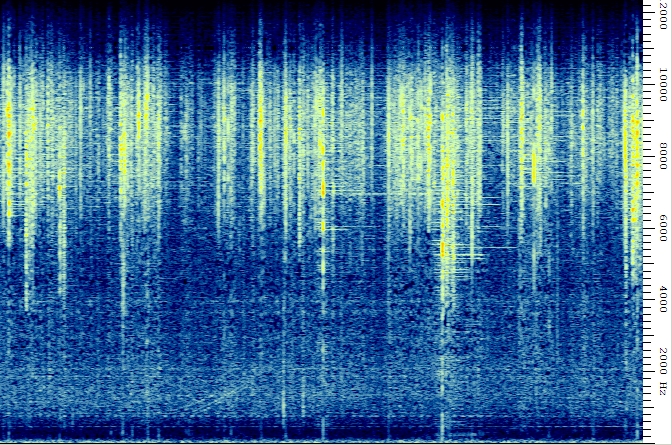
Remarkably good VLF signals received in Sheffield, streamed via the internet.
Excellent natural radio receivers, in near perfect locations, are available for remote listening on the internet. I suggest this method of listening, as it eliminates many of the very difficult antenna and noise challenges facing listeners in most locations. The streaming audio from these sites is reliable and of high quality, and one can easily hear sferics, submarine communications, and other signals in real time.
| LOCATION | STREAM TYPE |
| TERVAKOSKI, FINLAND **Software Defined Radio** | Tuneable SDR |
| ENSCHEDE, NETHERLANDS **Software Defined Radio** | Tuneable SDR |
| CAPE CORAL, FL, USA | MONO |
| SEBRING, FL, USA | MONO |
| MARLTON, NJ, USA | MONO |
| HAWLEY, TX, USA | MONO |
| BIELEFELD, GERMANY | MONO |
| CUMIANA, ITALY | MONO |
| SHEFFIELD, UK | MONO |
| TODMORDEN, UK | MONO |
| BIELEFIELD + CUMIANA | STEREO |
| MARLTON + SEBRING | STEREO |
| TODMORDEN + BIELEFIELD | STEREO |
| TODMORDEN + MARLTON | STEREO |
Streaming audio from the VLF receivers listed above are quite reliable; if one is offline, simply try one of the others. See also the Live VLF Natural Radio page for updates. Most fascinating to listen to are the stereo audio streams, which can become quite active during geomagnetic storms.. Start up the streams and listen to live natural radio today.
© 2005 - 2026 AB9IL.net, All Rights Reserved.
Written and curated by Philip Collier / AB9IL.
About Philip Collier / AB9IL, Commentaries and Op-Eds, Contact, Privacy Policy and Disclosures, XML Sitemap.