

Mediumwave and HF Stations to tune on the K3FEF WebSDR (Tuned: 1000 kHz)
RX888 + UberSDR, K3FEF / W3TKP, Milford, PA, USA
KiwiSDR, K3FEF / W3TKP, Milford, PA USA
RX-888 + Classic WebSDR, K3FEF / W3TKP, Milford, PA USA
WebSDRs Moving at the Speed of Thought
It was not long ago when I last wrote about some of my favorite WebSDRs switching from the classic backend and interface to more modern software. I was super pleased to find the K3FEF / W3TKP site had begun running the NovaSDR DSP and interface. It was around this time that they also started using broadband direct sampling hardware (RX-888 Mk II SDR). They stayed with NovaSDR it for a while, then moved on to the UberSDR package.
It seemed that the pace of WebSDR development was accelerating, as all sorts of new features were coming fast. I became a fan when the developers made synchronous AM demodulation a standard feature, bringing much more clean and distortion free AM mode reception. From there, and quickly, I noticed plenty of incremental improvements: smoother streaming, easier bookmark handling, and noise reduction.
As UberSDR’s features became more polished and debugged for people like myself, who mostly tune and listen to signals, work continued on a whole plethora of digital decoders. Not only was UberSDR improving in terms of how many different digital modes it could decode and show text for, but it also received abilities to skim the whole spectrum for a chosen type and decode those signals simultaneously. In other words, UberSDR was bade capable of listening for multiple WSPR or FT8 signals at once, and list decodes.
As quickly as users can find and report bugs or awkward functioning, developers are ever more quickly fixing things and improving the user experience. The lag time between thinking about a feature and its implementation is becoming less and less. And now there is UberSDR version 2.
UberSDR Version 2 - Major Upgrades and New Features
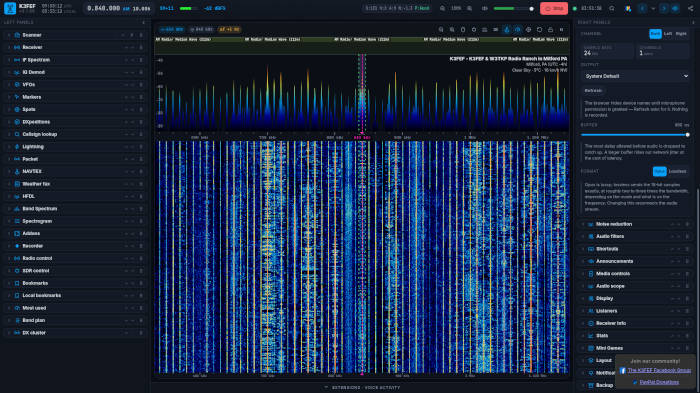
What struck me first about UberSDR v2 is its new look. The interface is more clean, making efficient use of screen space. There is a panel on the left with a series of mini panels for receiver controls, signal displays, and data decoding. On the right, there is another panel of useful controls, such as squelch, receiver buffer, noise reduction, and more. The large center panel shows a waterfall display, signal histogram, and controls for navigating the spectrum. The left and right panels may be hidden, further decluttering the interface.
Key new features and capabilities go far beyond what an internet user may see as they tune in their favorite stations. A great deal of the work for version 2 went into improving the back end software and running more efficiently on the site owner’s hardware. In order to stay relevant, WebSDR packages must accommodate more users, with lower latency, and use less RAM and CPU resources - all at the same time. There really is a squeeze happening, where more listeners are online, and owners want their system to handle the demand better than in the past.
Part of the solution is using more efficient signal processing, using every advantage the laws of mathematics and physics will allow. Using KA9Q-Radio for much of the DSP, and encapsulating UberSDR in Docker Images greatly improves things for host systems. Here is a summary of features:
- Smart Listen & Multi-Monitor: This feature allows real-time diversity reception using multiple instances simultaneously, with Smart Listen automatically switching audio to the instance with the strongest Signal-to-Noise Ratio (SNR) without manual intervention.
- Advanced Digital Decoders: The platform integrates native extensions for CW Spots, Digital Spots (FT8, FT4, FT2, WSPR, JS8), DX Cluster, SSTV, WEFAX, NAVTEX, FreeDV, Morse Code, Olivia, and Speech-to-Text.
- Server-Side DSP: High-quality noise reduction is provided via server-side processing, offering multiple algorithms including NR2 (MMSE-LSA), RN2 (RNN-based), NR4 (SPP-MMSE), and DFNR (neural network).
- API-Driven Architecture: The frontend is entirely API-driven, facilitating custom client applications and offline analysis of spectrum and decoded data, while maintaining compatibility with KiwiSDR protocols.
- Specialized Add-ons: New extensions include HFDL Monitor for simultaneous frequency monitoring, Doppler shift analysis across multiple WWV frequencies, and GPSDO synchronization for precision measurements.
- Native Clients: The v2 release supports a Desktop Client (with Rigctl, Flrig, OmniRig, and TCI support), a Minimal Audio Client for low-resource environments, and a Terminal Client for headless operation over SSH.
- Who Can Hear Me?: A propagation prediction tool that uses GPS/GeoIP and WSPR data to estimate which UberSDR instances can receive an SSB transmission at 100–200 W.
Tuning Around on the New K3FEF WebSDR
What I have always enjoyed on the W3FEF WebSDRs, in all of their versions, is the top notch reception. The site is in a location with very low powerline and electronic noise. You actually have to pay attention and search a bit to find noise from electronic devices or power lines. Furthermore, the receiver is very sensitive, even on the mediumwave / AM band. A lot of other sites filter out those signals, or just have crappy reception due to the antenna type in use. On the K3FEF WebSDR, I can tune in stations inaudible on other nearby sites.
On HF, the K3FEF WebSDR is also sensitive and robust. I sometimes am looking for maritime or aviation communications, and as long as the bands are open, I can pick up the signals. It is so nice to listen to a receiver which is so expertly configured that the only limiting factor is the natural propagation. You can contact the operators and engage with other users on the K3FEF / W3TKP SDR Facebook Group.
© 2005 - 2026 AB9IL.net, All Rights Reserved.
Written and curated by Philip Collier / AB9IL.
About Philip Collier / AB9IL, Commentaries and Op-Eds, Contact, Privacy Policy and Disclosures, XML Sitemap.