

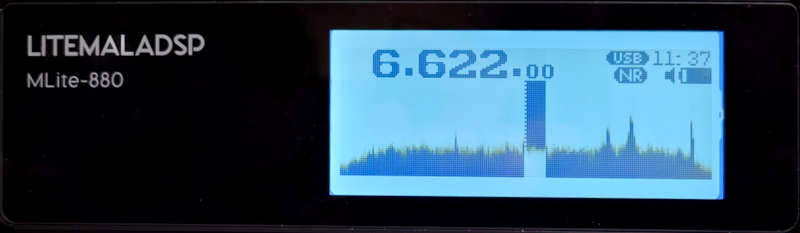
The Mlite-880 might well be my favorite portable radio alternative to an SDR feeding data to a desktop computer with all the bells and whistles a radio nerd would want. Except, sometimes, I really lean toward the small and portable Malahit DSP4 SDR, or its earlier versions - the DSP2 or DSP3, which themselves are great SDRs. Which radio would I want, if stuck on a desert island under a heavily traveled jet route (for airband radio listening)? LOL sometimes I say the same things about the receivers, but the truth is there are just so many cool receivers and so little time on Earth.
The MLite-880 (LITEMALADSP) is a simplified, lower-cost portable SDR designed to bring Malahiteam DSP performance to a traditional radio form factor, whereas the Malahit DSP2 is a premium, full-featured receiver with a color touchscreen and more advanced connectivity.
Physical Design and Display
The MLite-880 features a monochrome display and a traditional portable shape with a back-stand, making it more discreet and readable in sunlight than the DSP2’s 3.5-inch IPS color touchscreen. The DSP2 is housed in a distinctive metal “Star Trek” style cabinet, which some users find less conventional for public use.
Hardware and Performance
Both units utilize the STM32H743 microcontroller and share similar DSP algorithm quality, with the MLite-880 claiming slightly higher dynamic range in HF bands. However, the DSP2 includes a TCXO (temperature-compensated crystal oscillator) for superior frequency stability, while the MLite-880 uses a standard XO. The MLite-880 also lacks an internal ferrite bar for AM/MW, relying entirely on the whip or external antennas, whereas the DSP2 has more robust internal antenna switching and connectivity options.
Features and Usability
- DSP2: Offers upgradable firmware (v2.4+), Bluetooth, built-in FT8/RTTY/CW decoders, and synchronous detection with selectable sidebands.
- MLite-880: Provides essential features like noise reduction, synchronous detection (non-selectable sideband), and recording, but lacks hardware decoders for modes like FT8 and has a simpler spectrum display. It is actively supported with firmware updates that have expanded its frequency coverage up to 165 MHz.
MLite-880 - A Deceptively Simple Looking Radio With Great DSP
The MLite-880 is a high-performance portable SDR that prioritizes DSP processing power and battery life over traditional analog front-end components. Its specifications reveal a device designed for enthusiasts who value software flexibility and HF dynamic range, while accepting compromises in medium-wave convenience and frequency stability.
Processor and Signal Architecture
At the heart of the MLite-880 is the STM32H743 ARM Cortex-M7 microcontroller, clocked at 480 MHz. This powerful CPU handles the heavy lifting for real-time spectrum analysis and waterfall displays. Unlike entry-level DSP radios, it pairs this with a dedicated SI4732 DSP engine (or equivalent architecture) to manage demodulation. * Oscillator: It employs a standard XO (Crystal Oscillator). While functional, this lacks the temperature compensation (TCXO) found in the Malahit DSP2, leading to potential frequency drift (approx. 20–80 Hz) as the unit warms up or ambient temperatures change. * Dynamic Range: Despite the simpler oscillator, the RF front-end is optimized for HF, offering a dynamic range that reportedly exceeds the Malahit DSP3 by a few decibels in the HF bands, reaching over 100 dB in optimal conditions.
Frequency Coverage and Demodulation
Firmware updates through mid-2026 have expanded the receiver’s capabilities significantly beyond its initial launch specs. * Range: Continuous coverage from 130 kHz to 165 MHz. This encompasses Longwave (LW), Medium Wave (MW), Shortwave (SW), CB, FM Broadcast (64–108 MHz including OIRT), VHF Airband (118–137 MHz), and NOAA Weather (162 MHz). * Modes: Supports AM, SSB (USB/LSB), CW, SAM (Synchronous AM), NFM, and WFM. * Advanced AM: Recent firmware (v1.5.6+) introduced SAMU/SAML, allowing users to select upper or lower sidebands during synchronous AM detection to mitigate fading and interference. * Bandwidth: Highly adjustable filters, ranging from 0.15 kHz to 15 kHz for AM/SSB and 56 kHz to 311 kHz for FM.
The Ferrite Bar Compromise
A critical specification detail is the absence of an internal ferrite bar antenna for LW/MW. * Impact: The radio relies entirely on the telescopic whip or external antennas for these bands. While the DSP noise reduction is effective, indoor reception of medium wave stations can be significantly weaker and more prone to electrical interference compared to radios with internal ferrite rods (like the Tecsun PL-330 or Malahit DSP2). * Mitigation: Performance on MW improves drastically outdoors or when using a simple wire antenna plugged into the 3.5mm jack (adapter included).
Audio, Power, and Connectivity
- Audio Output: Features a robust 5W internal speaker and a 3.5mm headphone jack. Uniquely, it includes Bluetooth 5.0 transmission, allowing users to connect wireless headphones or external speakers directly to the radio.
- Battery: Powered by a removable 5000mAh 21700 Li-ion battery. This larger form factor battery (compared to standard 18650 cells) provides 5–8 hours of operation. It charges via USB-C.
- Recording: Includes a MicroSD slot (supports up to 16GB officially, though some users report success with larger cards using exFAT) for recording audio logs with timestamp and frequency data.
Display and Interface
- Screen: A 192x64 pixel monochrome LCD. While lacking the color resolution of the Malahit DSP2, this display is highly legible in direct sunlight and consumes less power.
- Controls: Physical knobs for volume/tuning and navigation. Firmware updates have added features like an Activity Timer (auto-shutoff) and improved menu navigation to reduce encoder wear.
Based on user reviews and field tests from mid-2026, the MLite-880 is judged as a high-value “bang-for-buck” SDR that successfully ports premium Malahit DSP algorithms into a traditional, sunlight-readable portable form factor. While praised for its HF performance and noise reduction, users consistently note compromises in Medium Wave (MW) sensitivity and frequency stability compared to higher-end models.
Top-Rated Features of the MLite-880
- DSP Noise Reduction (NR): Widely considered the radio’s standout feature. Users report the NR (levels 0–15) is exceptionally effective at pulling weak signals out of noise on AM and Shortwave without introducing significant “underwater” artifacts, often outperforming competitors in the same price class.
- Sunlight-Readable Display: The monochrome LCD is frequently praised for being perfectly legible in direct sunlight, a distinct advantage over the reflective color touchscreens of the Malahit DSP2/DSP3 which can be difficult to see outdoors.
- Synchronous AM (SAM): The synchronous detector is rated highly for locking onto fading signals and reducing multipath distortion. Recent firmware updates (v1.5.6+) adding selectable sidebands (SAMU/SAML) have further elevated user satisfaction for DXing.
- Battery Life & Form Factor: The 5000mAh 21700 battery provides reliable 5–8 hour runtime, and the traditional “stick” shape with a kickstand is preferred by many for field use over the “Star Trek” slab design of other Malahit units.
- Active Firmware Support: Users appreciate the rapid update cycle (reaching v1.5.8 by mid-2026), which has added critical features like VHF weather bands, CW offset tuning, and activity timers.
Performance Judgments & Criticisms
- HF/SW Performance: Rated as excellent. Enthusiasts note that dynamic range on HF bands often rivals or slightly exceeds the Malahit DSP3 due to effective internal shielding and RF optimization. It is frequently described as “sensitive” and “robust” against overloading.
- MW/LW Limitations: The lack of an internal ferrite bar is the most common criticism. Users find MW reception indoors to be mediocre compared to radios like the Tecsun PL-330 or Malahit DSP2. Performance improves significantly outdoors or with an external wire antenna, but the reliance on the whip is seen as a drawback for casual indoor listening.
- Frequency Stability: Because it uses a standard XO instead of a TCXO, users report noticeable frequency drift (20–80 Hz) as the unit warms up. While the fine-tuning calibration feature (0.1 PPM steps) helps, it requires manual adjustment, unlike the rock-solid stability of the DSP2.
- VHF Sensitivity: While coverage extends to 165 MHz, sensitivity above 148 MHz is reported to drop off, making it less ideal for serious VHF/UHF scanning compared to dedicated scanners, though sufficient for occasional Airband and Weather monitoring.
Verdict from the Community
The consensus is that the MLite-880 is the best portable SDR under $250 for users who prioritize HF/Shortwave listening and outdoor usability. It is judged as a “smart compromise”: you lose the color screen, internal ferrite, and TCXO of the expensive Malahit DSP2, but you gain a rugged, sunlight-readable radio with nearly identical DSP audio quality for a fraction of the price.
Malahit DSP2
The Malahit DSP2 distinguishes itself through a premium hardware architecture designed for stability and advanced digital decoding, setting it apart from simplified clones like the MLite-880. Its specifications reflect a focus on HF/VHF/UHF versatility and “rock-solid” frequency accuracy.
Advanced Hardware Architecture
The core of the DSP2 is the STM32H743 ARM Cortex-M7 microcontroller (480 MHz) coupled with a Mirics MSi001 wideband tuner. This combination enables a dynamic range of 82 dB and sensitivity of 0.3 µV up to 1 GHz. * Frequency Stability: The defining hardware upgrade over budget models is the integrated TCXO (Temperature-Compensated Crystal Oscillator). Rated at ±1.0 ppm (often performing better at ±0.5 ppm), it ensures frequency drift remains negligible (<10 Hz) even as the unit warms up, eliminating the need for frequent manual recalibration during weak signal work. * Display Interface: It utilizes a 3.5-inch IPS capacitive touchscreen (480x320 resolution). While vibrant and capable of rich waterfall displays, the series-connected design in early batches occasionally introduced display noise, a layout later revised in the DSP3 successor.
Frequency Coverage and Digital Decoding
The receiver covers 10 kHz to 380 MHz and 404 MHz to 2 GHz, intentionally skipping the 380–404 MHz band to avoid cellular interference. * Modes: Supports standard analog modes (AM, SSB, DSB, CW, NFM, WFM) with stereo FM and RDS. * Built-in Decoders: Firmware v2.4 introduced standalone hardware decoders for FT8 and RTTY. This allows users to decode weak digital signals directly on the touchscreen without a PC connection, a feature absent in the MLite-880. * Synchronous Detection: Includes advanced Synchronous AM (SAM) with selectable sidebands to mitigate multipath fading on shortwave.
RF Front-End and Antenna System
- Internal Ferrite Antenna: Unlike the MLite-880, the DSP2 includes a built-in ferrite bar for LW/MW. This significantly improves indoor medium wave reception, though some users note that early production runs suffered from Bias-Tee interference on these bands, which was mitigated in later units and the DSP3.
- Connectivity: Features a 50Ω SMA female connector, Bias-Tee power for active antennas, and a software-switchable High-Impedance (Hi-Z) mode for random wire antennas. It also includes a variable RF attenuator (0–30 dB) to prevent overload from strong local signals.
- Audio: Equipped with dual front-facing speakers and a 3.5mm stereo jack.
Power and Physical Build
- Battery: Houses a built-in 5000mAh Li-ion battery, providing 5–7 hours of operation. Charging is via Micro-USB (a legacy port replaced by USB-C in the DSP3).
- Enclosure: Constructed from a solid aluminum alloy chassis (approx. 145 x 95 x 30 mm, ~500g). The “slab” design is durable but less pocket-friendly than stick-style radios.
- Controls: Uses two IP6X-rated mechanical rotary encoders with push-buttons, supplemented by the touchscreen interface.
Production Status and Legacy
As of late 2022, the Malahit DSP2 is no longer in production, having been superseded by the DSP3. The DSP3 addressed specific hardware grievances of the DSP2, including: * Replacing Micro-USB with USB-C. * Adding an SD card slot for audio recording. * Redesigning the touchscreen connection to eliminate display-induced noise. * Fixing the Bias-Tee circuit to restore full LW/MW performance with the internal ferrite.
The Malahit DSP3 represents a critical “fix-it” iteration in the Malahit lineage, designed specifically to resolve hardware flaws in the DSP2 while maintaining the same external form factor. Its specifications are defined by internal circuit redesigns rather than new feature additions.
Core Hardware Specifications
- Processor & Tuner: Retains the STM32H743 ARM Cortex-M7 (480 MHz) and the Mirics MSi001 tuner found in the DSP2. This continuity ensures compatibility with existing firmware but ties the unit to the global shortage of the Mirics chip.
- Frequency Stability: Equipped with a TCXO (±1.0 ppm), ensuring frequency drift remains negligible (<10 Hz) during operation.
- Frequency Coverage: 50 kHz – 380 MHz and 404 MHz – 2 GHz. Unlike the newer DSP4, the DSP3 retains the “gap” between 380–404 MHz to avoid cellular interference.
- Display: 3.5-inch IPS color touchscreen (480x320). The critical spec change here is the interface wiring, switched from series to parallel to eliminate display-generated noise on lower bands.
Critical Design Improvements (vs. DSP2)
The DSP3’s value proposition lies in three specific engineering corrections: 1. Noise-Free Display: The parallel touchscreen connection eliminates the high-pitched “whine” that interfered with LW/MW reception on early DSP2 units. 2. Functional Bias-Tee: The antenna input circuit was redesigned. On the DSP2, engaging the Bias-Tee (for active antennas) often degraded or disabled the internal ferrite antenna performance. The DSP3 allows simultaneous use of the internal ferrite bar and Bias-Tee power without signal loss. 3. Modern I/O: Upgraded to USB-C for charging and data, and added a MicroSD card slot (supporting up to 32GB) for direct audio and IQ recording, a feature completely absent in the DSP2.
Performance Metrics
- Dynamic Range: Approximately 85 dB (blocking dynamic range). This is lower than the newer DSP4 (100 dB) but sufficient for most portable listening scenarios.
- Bandwidth: Maximum IF bandwidth of 192 kHz.
- Sensitivity: Rated at 0.3 µV (approx. -115 dBm) for SSB/NFM up to 1 GHz.
- Power: Powered by a removable 18650 Li-ion battery (typically 3000–3600mAh in standard kits, though some vendors ship with higher capacity cells), offering 5–7 hours of life. It is known for low power consumption compared to the newer DSP4.
Current Status (August 2026)
As of today, the DSP3 is discontinued. Production ceased in early 2026 due to the unavailability of the Mirics MSi001 tuner chip. It has been replaced by the Malahit DSP4, which uses a new tuner architecture to achieve 650 kHz bandwidth and 100 dB dynamic range, albeit with higher power consumption. Consequently, the DSP3 is now a “legacy premium” unit, valued for its mature firmware and proven stability, available only as new old stock or on the secondary market.
The Latest and Greatest - The Malahit DSP4
The Malahit DSP4 is the latest successor to the discontinued DSP3, officially announced in March 2026 to address the global shortage of the Mirics MSI001 tuner chip. While it retains the identical external “slab” design and control layout of the DSP3, it features a completely redesigned internal RF architecture that delivers significant performance gains at the cost of higher power consumption.
Performance and Bandwidth
The most critical upgrade is the radio receiving solution, which is more advanced than the DSP3’s Mirics-based design. * Bandwidth: The DSP4 offers a massive 650 kHz instantaneous bandwidth, a more than 3x increase over the DSP3’s 192 kHz limit. This allows for much wider spectrum visualization and analysis. * Dynamic Range: The blocking dynamic range has improved to ≥100 dB (vs. ~85 dB on the DSP3), making it significantly more robust against strong signal overload. * Sensitivity: Sensitivity is improved to ≤ -140 dBm on HF and noticeably better on VHF bands compared to the DSP3. * Frequency Coverage: It covers 100 kHz to 1.7 GHz continuously. Unlike the DSP3, it has no “holes” (the 380–404 MHz cellular gap is removed), though the upper limit is slightly lower than the DSP3’s 2 GHz.
Connectivity and Features
- Bluetooth & Clock: The DSP4 includes a built-in Bluetooth module and a dedicated clock chip, features absent in the DSP3.
- Recording: Like the DSP3, it supports recording to a MicroSD card, but firmware updates (as of August 2026) have expanded this to include DMR, APCO, and SSTV decoders, along with FT4/FT8 logging.
- RDS Reception: FM Radio Data System (RDS) decoding is significantly improved over the DSP3.
Power and Trade-offs
- Power Consumption: The advanced architecture comes with a penalty: the DSP4 consumes 1.5 to 2 times more power than the DSP3. While the DSP3 was renowned for low-power efficiency, the DSP4 requires more frequent battery changes or charging.
- IQ Bandwidth: While the RF bandwidth is higher, the IQ signal transmission bandwidth to a PC is slightly lower at 162 kHz (vs. 192 kHz on the DSP3).
- Tuning Artifacts: Early user reports (mid-2026) note a “crackling” sound when retuning frequencies, a quirk not present on the DSP3, though firmware updates are expected to mitigate this.
Summary Comparison Table
| Feature | Malahit DSP3 | Malahit DSP4 |
|---|---|---|
| Tuner Architecture | Mirics MSI001 (Discontinued) | New Proprietary/Advanced Solution |
| Bandwidth | 192 kHz | 650 kHz |
| Dynamic Range | ~85 dB | ≥100 dB |
| Frequency Range | 50 kHz – 2 GHz (with gap) | 100 kHz – 1.7 GHz (Continuous) |
| Connectivity | USB-C | USB-C + Bluetooth |
| Power Consumption | Low (Efficient) | High (1.5–2x DSP3) |
| Special Features | SD Recording, Parallel Display | Built-in Clock, DMR/APCO Decoding |
Shortwave and VHF enthusiasts favor the Malahit DSP4 because it delivers base-station-grade performance in a portable form factor, specifically addressing the dynamic range and bandwidth limitations of previous models.
Unmatched Signal Clarity and Stability
The primary draw for serious DXers is the DSP4’s ≥100 dB dynamic range, a significant leap from the DSP3’s ~85 dB. This allows the radio to resolve weak shortwave signals even in the presence of strong local broadcast interference or during solar flares, preventing the “blocking” or desensitization common in lower-tier receivers. Additionally, its sensitivity of ≤-140 dBm on HF and noticeably improved VHF sensitivity ensures that faint meteor scatter, tropospheric ducting, or distant shortwave broadcasts are pulled from the noise floor with exceptional clarity.
Wideband Spectrum Visualization
For VHF enthusiasts and spectrum hunters, the DSP4’s 650 kHz instantaneous bandwidth (over 3x that of the DSP3) is a game-changer. This allows users to visualize and monitor a massive slice of the spectrum simultaneously—crucial for tracking frequency-hopping signals, analyzing complex VHF data bursts, or scanning wide shortwave bands without missing activity between tuning steps. The continuous coverage from 100 kHz to 1.7 GHz also eliminates the 380–404 MHz “hole” found in the DSP3, ensuring no gaps in monitoring capabilities.
Premium Convenience Features
The DSP4 integrates modern conveniences that streamline the listening experience: * Built-in Bluetooth: Enables wireless headphone connectivity, reducing cable clutter during field operations or home listening. Unlike previous models requiring external dongles, this is integrated directly into the mainboard. * Internal Clock Chip: Provides accurate timekeeping for logging signal reports and synchronizing digital modes without external references. While the DSP2/3 had software clocks, the DSP4’s dedicated hardware chip maintains time more reliably. * Enhanced RDS: Significantly improved Radio Data System decoding for FM broadcast monitoring compared to the DSP3, making it a superior choice for urban FM DXing.
While the DSP4 consumes 1.5–2x more power than the DSP3, premium users accept this trade-off for the professional-grade RF architecture that rivals desktop SDRs, making it the ultimate choice for those who refuse to compromise on portable performance.
© 2005 - 2026 AB9IL.net, All Rights Reserved.
Written and curated by Philip Collier / AB9IL.
About Philip Collier / AB9IL, Commentaries and Op-Eds, Contact, Privacy Policy and Disclosures, XML Sitemap.