
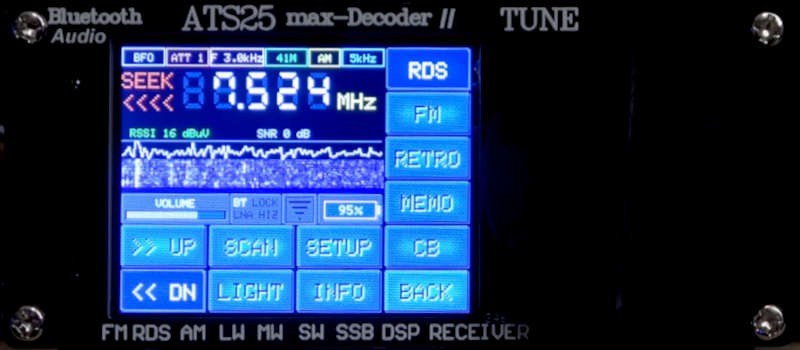
When thinking of the perfect portable shortwave radio, which can also receive great mediumwave and longwave, I often think of the small but nicely performing ATS-25, ATS-20, and other lightweight receivers built around the SI4732 and SI4735 chips. These are almost perfect radios, with a nice frontend, a low-IF design, and importantly for me, digital demodulation and DSP features unavailable on analog portables. These receivers are almost like having a Softrock SDR, for all bands, and miniaturized to a crazy level.
If I could choose what radio to be stuck on a desert island with, it could well be a SI4732 or SI4735 based receiver, if I could have a good pair of earbuds to go with the radio. LOL sometimes I say the same things about the receivers, but the truth is there are just so many cool receivers and so little time on Earth.
Shortwave and Mediumwave listeners favor receivers based on the SI4732 and SI4735 chips because they deliver high-performance Digital Signal Processing (DSP) features at a fraction of the cost of traditional analog radios.
Here are 5 popular receivers based on the SI4732 and SI4735 chips, ranging from commercial models to enthusiast DIY kits:
| Model | Chip Variant | Type | Key Features |
|---|---|---|---|
| Tecsun PL-330 | SI4735-D60 | Commercial | Compact portable with SSB, Sync AM, ETM+ scanning, and USB-C charging. Widely considered the benchmark for budget DSP portables. |
| CountyComm GP-7/SSB | SI4735-D60 (Gen 5) | Commercial | Ruggedized “general purpose” radio featuring a custom 27” stainless steel antenna, selectable bandwidth filters, and high-fidelity audio. |
| XHDATA D-808 | SI4735-D60 | Commercial | Larger desktop-style portable with Airband reception, RDS, extensive memory (500 stations), and superior speaker audio quality. |
| ATS-20+ | SI4732-A10 | DIY/Kit | Extremely popular, ultra-compact kit radio featuring a color IPS screen, ESP32 microcontroller, and active community firmware support. |
| ATS-25 MAX | SI4732-A10 | DIY/Kit | An evolution of the ATS-20+ with a larger display, improved ergonomics, and a built-in 4000mAh battery for extended field use. |
Superior Selectivity and Interference Rejection
The primary advantage for DXers (long-distance listeners) is the ability to separate weak signals from strong adjacent channels. * Selectable Bandwidth: Listeners can narrow the audio filter (e.g., to 1.0 kHz or 2.2 kHz) to cut through noise and isolate specific voices on crowded Shortwave bands. * Image Rejection: The SI4735-D60, in particular, is noted for improved HF image rejection compared to earlier chips, resulting in a quieter background on higher frequency bands (10m and 15m). * Sync AM: On Mediumwave, the “Synchronous AM” mode (enabled via SSB patch) eliminates the distortion caused by carrier fading, a common issue at night when skipping signals interfere with each other.
Frequency Stability and Precision
Unlike analog radios that suffer from “drift” (where the frequency slowly shifts, requiring constant retuning), these chips use a digital synthesizer. * Lock Stability: Stations remain locked precisely on frequency, which is critical for monitoring stable utility stations or amateur radio operators. * Fine Tuning: Users can tune in precise 10 Hz or 100 Hz steps to center a signal perfectly within the filter passband, maximizing clarity.
Portability and Power Efficiency
These chips are designed for battery-operated mobile devices, making them ideal for field listening (SOTA/POTA). * Low Power Draw: Radios like the Tecsun PL-330 or DIY ATS-20+ can run for weeks on standard AA batteries. * Compact Form Factor: The high integration of the chip allows for very small radios that still perform like larger desktop units.
Accessibility of SSB Mode
Historically, Single Sideband (SSB) reception required expensive equipment. The SI4732 and SI4735 brought this capability to the mass market. * Amateur Radio Access: Listeners can easily tune into ham radio operators, maritime traffic, and utility stations that do not broadcast on standard AM. * Cost Efficiency: This functionality is now available in radios costing under $50, democratizing access to modes previously reserved for hobbyists with large budgets.
Key Features of the SI4735-D60
The Silicon Labs SI4735-D60 is a fully integrated CMOS AM/FM/SW/LW radio receiver known for its digital signal processing (DSP) capabilities and low power consumption.
Core Specifications
- Frequency Coverage: Supports worldwide FM (64–108 MHz), AM (520–1710 kHz), Shortwave (2.3–26.1 MHz), and Longwave (153–279 kHz).
- Digital Architecture: Utilizes a digital low-IF architecture that eliminates the need for manual alignment or factory adjustments.
- Signal Processing: Features Automatic Frequency Control (AFC), Automatic Gain Control (AGC), and seven selectable AM channel filters for improved selectivity.
- Data Support: Includes an integrated processor for RDS (Radio Data System) and RBDS, enabling station identification and song info display.
- Audio Quality: Delivers a high signal-to-noise ratio (typically 58 dB for FM) with a digital stereo decoder and programmable de-emphasis.
- SSB Capability: Unlike standard AM chips, the SI4735-D60 supports Single Sideband (SSB) reception (LSB/USB) when a specific firmware patch is loaded via the I²C interface.
Synchronous AM (SAM) Reception
Synchronous AM (often labeled as AM-Sync or S-AM) is a demodulation technique available on radios using the SI4735-D60 (typically via its SSB patch mode) that significantly improves reception quality compared to standard envelope detection.
How It Works
In standard AM reception, the receiver uses the transmitted carrier wave to demodulate the audio. However, on shortwave and medium wave, this carrier often suffers from selective fading, where the carrier strength drops relative to the sidebands, causing severe distortion and “hollow” sound.
Synchronous detection solves this by:
- Replacing the Carrier: The receiver ignores the fading incoming carrier and instead generates a stable, local carrier signal internally.
- Phase Locking: This local carrier is synchronized in frequency and phase with the incoming signal (often using a Phase Locked Loop or DSP algorithms).
- Product Detection: The stable local carrier is mixed with the incoming sidebands to recover the audio, effectively bypassing the distortion caused by carrier fading.
Benefits of SAM
- Elimination of Fading Distortion: Prevents the “screechy” or distorted audio that occurs when the carrier wave fades out during standard AM reception.
- Improved Selectivity: Allows the user to tune in either the Upper Sideband (USB) or Lower Sideband (LSB). This helps eliminate adjacent channel interference (e.g., a station on 9.495 MHz interfering with one on 9.500 MHz) by filtering out the unwanted sideband.
- Better Weak Signal Performance: Synchronous detectors do not have the forward-bias voltage threshold issues of diode detectors, allowing for clearer demodulation of very weak signals.
- Stable Audio Levels: Provides more consistent audio output even when signal strength fluctuates rapidly.
SSB Reception Quality: SI4732 vs. SI4735
Radios based on the SI4732-A10 and SI4735-D60 chips offer comparable high-quality SSB reception because they utilize the exact same firmware patch to enable Single Sideband mode. There are no significant differences in demodulation performance, audio fidelity, or synchronous detection capabilities between the two when running identical firmware.
Identical Core Performance
- Shared Firmware: Both chips require a proprietary binary patch loaded via the I²C interface to unlock SSB (LSB/USB) and synchronous AM modes. The community-developed patches (e.g., by PU2CLR) are designed to work identically on both the SI4732-A10 and SI4735-D60.
- DSP Architecture: Both utilize the same digital low-IF architecture, providing identical selectivity, image rejection, and automatic gain control (AGC) behaviors in SSB mode.
- Filter Options: Both chips support the same selectable audio bandwidth filters for SSB, typically ranging from 0.5 kHz to 4.0 kHz (e.g., 0.5, 1.0, 1.2, 2.2, 3.0, 4.0 kHz), allowing users to optimize for voice clarity or noise reduction.
- Synchronous Detection: The “Synchronous AM” capability is effectively a byproduct of the SSB patch; both chips perform equally well in suppressing carrier fading and selecting sidebands to reduce interference.
Key Differences (Non-Audio)
While reception quality is virtually indistinguishable, there are minor distinctions in implementation and availability:
- I²C Addressing: The chips differ in their default
I²C bus address logic. The SI4735-D60 typically uses address
0x11when the SEN pin is grounded, whereas the SI4732-A10 often uses the same address when SEN is pulled high. This requires minor wiring or code adjustments in DIY projects but does not affect RF performance. - Market Availability: The SI4732-A10 has become more prevalent in recent budget-friendly DIY kits (e.g., ATS-20+, ATS-25) and portable units, partly due to supply chain shifts. The SI4735-D60 is found in slightly older or higher-end commercial models like the Tecsun PL-330.
- Documentation: The SI4735-D60 generally has more extensive official documentation regarding its “D60” revision features, though the community library support (e.g., PU2CLR) treats them almost interchangeably for SSB applications.
Conclusion on Quality
For the end user listening to SSB or synchronous AM, there is no perceptible difference in signal quality between a radio using the SI4732 and one using the SI4735. Performance variations between radios are almost exclusively due to external factors such as: * Antenna design and impedance matching. * Front-end filtering (to prevent overload from strong local signals). * Audio amplifier quality and speaker/headphone output. * Shielding against internal digital noise (e.g., from the display or microcontroller).
No VLF Reception on Si4732 / Si4735 Receivers
No, native VLF (Very Low Frequency, 3–30 kHz) reception is not possible with radios based on the SI4732-A10 or SI4735-D60 chips.
Hardware Limitations
The silicon architecture of both chips has a hard frequency floor well above the VLF band: * Longwave (LW) Minimum: The lowest supported frequency is 150 kHz (specifically 153 kHz in most implementations). * VLF Gap: The VLF spectrum (3–30 kHz) lies significantly below the chip’s operational range. There is no firmware patch, software modification, or “hack” (including the popular PU2CLR libraries) that can extend the digital tuning below the hardware-defined 150 kHz limit. * Antenna Input: The chip’s internal analog front-end and antenna tuning circuitry are optimized for frequencies starting at 150 kHz; signals at VLF frequencies would be effectively filtered out or attenuated to unusable levels before digital processing.
Common Confusion: “Extended LW” vs. VLF
Some DIY projects (e.g., ATS-20+, ATS-25, or Mini V3/V4) advertise coverage down to 9 kHz or 10 kHz. This is often a misunderstanding of the specifications: * Step Size vs. Reception: While some firmware allows tuning steps or display frequencies down to 9 kHz, the actual reception capability remains limited by the hardware to ~150 kHz. * Aliasing/Images: Any signals heard below 150 kHz on these devices are typically image frequencies, aliases, or internal oscillator noise, not genuine VLF reception.
Alternatives for VLF
To receive VLF signals (such as submarine communications, time signals, or natural atmospheric phenomena), you must use: * Dedicated VLF Receivers: Specialized hardware designed for 3–30 kHz. * SDR (Software Defined Radio): Devices like the RTL-SDR (with direct sampling mod), Airspy HF+, or Red Pitaya, which have front-ends capable of tuning down to 0 Hz (DC) or very low kHz ranges. * Sound Card Interfaces: Simple VLF antennas connected directly to a computer’s microphone input, utilizing the sound card as an ADC (Analog-to-Digital Converter).
No VLF Hacks Possible
Neither the SI4732-A10 nor the SI4735-D60 can accept tuning or frequency entries down to VLF frequencies.
Hard Frequency Floor
Both chips have a strict hardware-imposed lower limit of 150 kHz (153 kHz in many commercial implementations): * Minimum Tunable Frequency: The official Silicon Labs specifications and the widely used PU2CLR Arduino library explicitly define the operational range for AM/SSB modes as 150 kHz to 30 MHz. * Command Rejection: Attempting to send a frequency command below 150 kHz (e.g., 30 kHz for VLF) via the I²C interface will result in an error or be ignored by the chip’s internal processor. The firmware patches used to enable SSB mode do not alter this fundamental frequency boundary. * Experimental Confirmation: DIY builders attempting to receive signals like the 77.5 kHz DCF77 time signal have confirmed that the chips simply cannot tune below the 150 kHz threshold, regardless of software modifications.
Clarification on “9 kHz” Claims
Some radios based on these chips may display frequencies as low as 9 kHz or allow 1 kHz tuning steps, but this is misleading: * Display vs. Reception: The microcontroller driving the display might allow the user to scroll down to low numbers, but the SI4732/SI4735 silicon itself will not demodulate any signal below its 150 kHz floor. * No VLF Aliasing: Unlike some wideband SDRs that might show VLF signals as aliases or images, the DSP architecture of these chips filters out sub-150 kHz inputs entirely at the analog front-end stage.
For VLF reception (3–30 kHz), you must use a dedicated VLF receiver, a sound-card interface, or an SDR with direct sampling capability (e.g., RTL-SDR v3 with bias tee modifications or Airspy HF+).
The Logical Culmination of SoftRiock Type SDRs, and Good
Radio listeners favor receivers based on the SI4732 and SI4735 chips primarily for their exceptional value, compact size, and advanced Digital Signal Processing (DSP) features that were previously found only in expensive equipment.
Unbeatable Price-to-Performance Ratio
The most significant driver of popularity is cost. These chips enable SSB (Single Sideband) reception—a mode essential for amateur radio and utility listening—in devices costing $30–$60. Historically, portable radios with stable SSB capability cost hundreds of dollars. Listeners appreciate getting “high-end” features like synchronous detection and selectable bandwidth filters in a budget-friendly package.
Superior DSP Selectivity and Stability
Unlike traditional analog superheterodyne radios, the SI4732/SI4735 architecture processes signals digitally: * Sharp Filtering: Users can select specific bandwidths (e.g., 0.5 kHz to 4.0 kHz) to cut through interference and noise, a critical feature for crowded shortwave bands. * Frequency Stability: The digital synthesis eliminates the “drift” common in analog radios, keeping stations locked precisely on frequency without constant retuning. * Synchronous AM: The ability to switch to SSB mode to listen to standard AM broadcasts allows users to eliminate fading distortion and adjacent channel interference, significantly improving listenability on medium and shortwave.
Extreme Portability and Low Power
These chips are designed for mobile integration, resulting in radios that are: * Tiny: Many implementations (like the ATS-20+ or Mini V4) fit in a shirt pocket. * Efficient: They consume very little power, often running for weeks on standard AA batteries, making them ideal for field listening (SOTA/POTA) and emergency preparedness.
Active DIY and Firmware Community
A unique aspect of these receivers is the vibrant community support, particularly the libraries developed by PU2CLR. This allows users to: * Customize: Modify firmware to add features like RTTY/CW decoding, custom frequency steps, or enhanced display data. * Experiment: Builders enjoy the ability to construct their own high-performance receivers from kits, tailoring the antenna and audio stages to their specific needs.
© 2005 - 2026 AB9IL.net, All Rights Reserved.
Written and curated by Philip Collier / AB9IL.
About Philip Collier / AB9IL, Commentaries and Op-Eds, Contact, Privacy Policy and Disclosures, XML Sitemap.